Unintentionally Encouraging Misbehavior
by Kathy Slattengren, M. Ed., Priceless Parenting (sign up for monthly parenting newsletter and receive 20+ printable charts for kids and parents)
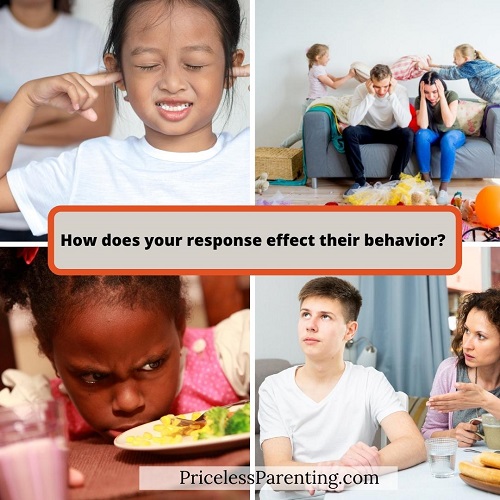
Do you ever find yourself feeling exasperated with your children’s continual misbehavior? If so, you’re like many other parents! You may even feel like shouting at your kids “Why can’t you just behave!”
So why do your children behave the way they do? According to the late psychologist Alfred Adler, all behavior serves a purpose. The most basic purposes are for two things:
- Belonging – feeling a sense of connection
- Meaning – feeling a sense of significance
When your kids are misbehaving, they often feel a greater sense of connection to you because you pay a lot of attention to them. They may also feel a sense of significance because they know how to push your buttons and make you react. Now there’s some power!
Let’s look at how this works in a couple situations.
My Children Don’t Listen
Do you ever find yourself having to repeat the same thing multiple times before your children actually listen? Children who don’t listen often have been unintentionally taught not to listen.
How do you teach your kids to not listen? You reinforce not listening whenever you ask your child to do something but then don’t immediately follow through when your child ignores the request.
For example, a mom and 8-year-old daughter were out for a walk. There was a grassy bank next to the sidewalk and the girl walked up on the hill. The mom told her “Don’t walk in the wet grass!” The girl continued walking along the hill for another minute or two before the mom continued “I asked you to get off the wet grass!” The girl still didn’t respond and so the mom, now irritated, began counting “That’s 1, that’s 2”, before she hit “3” the girl was back on the sidewalk.
This girl typically waits until her parents are angry before she pays attention to their requests. This not listening behavior gets her lots of her parents’ attention!
If you make a request and your child ignores it, you need to take action. In this example, the mother could have walked up the hill, taken her daughter’s hand and led her back to the sidewalk.
My Children Fight With Each Other
Sibling rivalry is another common complaint. How do you react when your children are fighting? When kids can get you involved in their fights, they feel a sense of connection to you and also feel significant – fulfilling Adler’s two basic purposes of behavior!
If you’re not afraid of your children really hurting each other, then the best approach is to let them work it out on their own. The less attention you give their fighting, the sooner it will end. If their fighting is bothering you, you can ask them to take it outside or to the garage – an uncomfortable location will shorten the fight!
Another approach is to remove yourself by doing something like going outside to work in the garden. By avoiding becoming involved in their fights, you also avoid adding fuel to the fire!
My Children Have Meltdowns
No parent wants to deal with tantrums and meltdowns – and yet all children will exhibit this behavior at some point. Tantrums are a dramatic way of getting your attention. When your child is having a meltdown, he is flooded with emotion and his rational thinking is not engaged.
If you react to a meltdown by giving in or providing a lot of attention, you will reinforce the behavior. If instead you stay calm and allow your child time and space to calm down, your child will be learning how to soothe himself and gain emotional control.
My Child Has a Bad Attitude
What’s your reaction when your child does something like rolls her eyes at you? Do you respond with a command like “Don’t you roll your eyes at me!” If so, she’s getting some attention from you and knows how to get more attention whenever she wants it.
What could you do instead so that you don’t fuel this behavior? You could calmly say “I’ll be happy to talk to you when you are being respectful” and walk away. By telling her what you are going to do instead of what she has to do, you can make it happen.
Considering Your Parenting Role
You can only change your own behavior. However, when you change your behavior, the behavior of your children will also change.
In fact, if your child is typically successful with a behavior like nagging, her nagging may initially increase when you stop responding to it. Children will try hard to provoke the old response from you. But if you stick with your new response, they will learn that nagging no longer works with you.
Take a step back and consider how your reaction may be accidentally encouraging the very behavior you do not want to see in your children. Try changing your behavior so that your kids experience plenty of connection with you and significance without resorting to misbehaving.